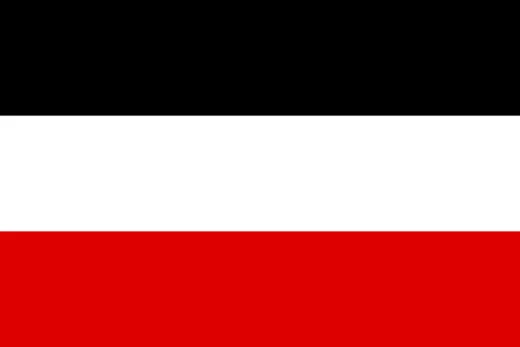
German Reich
Constitutional name for the German nation state from 1871 to 1945.
The German Reich (from the German *Deutsches Reich*, meaning "German Empire" or "German Realm") was the official name of the German nation‑state from 1871 until 1945. Its authority and sovereignty were understood to flow entirely from a continuous, unified German *Volk* (national people), exercised over a single German state territory whose borders and extent could shift. Though often translated as "German Empire," the word *Reich* is better rendered as "realm" or territorial "reach," since it carries no inherent monarchical meaning.
The name "German Reich" was first proclaimed on 18 January 1871 at the Palace of Versailles by Otto von Bismarck and Wilhelm I of Prussia. Following the annexation of Austria on 12–13 March 1938, the term "Greater German Reich" (*Großdeutsches Reich*) came into use alongside the official name. By decree of Reich Chancellery chief Hans Lammers on 26 June 1943, "Greater German Reich" became mandatory in official documents.
The German Reich effectively collapsed with the surrender of the Flensburg Government on 23 May 1945, though its authority had been severely limited after Adolf Hitler’s death on 30 April 1945. The Allies refused to recognize Karl Dönitz as Reich President and granted no legitimacy to the Flensburg Government he formed. On 5 June 1945, the Allies issued the Berlin Declaration on Germany’s defeat, establishing the Allied Control Council and assuming supreme authority over German territory.
After its founding on 23 May 1949, the Federal Republic of Germany claimed—within its own borders—to be a continuation of the German Reich, not merely a successor state. However, it did not retain the title "German Reich," consistently replacing the prefix *Reichs-* in all official titles and designations with *Bundes-* ("Federal"). For example, the office of *Reichskanzler* became *Bundeskanzler*. Following German reunification on 3 October 1990, the enlarged Federal Republic refers to itself as "United Germany," emphasizing that it does not recognize any territories once part of the former German Reich outside its current boundaries as having a valid claim to be part of Germany as a whole.
Historians use the partially translated phrase "German Reich" to refer to the entire period from 1871 to 1945 in formal contexts. In common English usage, this state was and is simply called Germany, while the term "German Empire" is re
- born
- 1871 (proclaimed 18 January 1871 at the Palace of Versailles)
- died
- 1945 (de facto collapsed 23 May 1945 with the surrender of the Flensburg Government; Allies assumed supreme authority on 5 June 1945)
- field
- Constitutional history, statehood, political organization
- nationality
- German
- known_for
- Constitutional name for the German nation state from 1871 to 1945; divided into German Empire (1871–1918), Weimar Republic (1918–1933), and Nazi Germany (1933–1945); later informally called Greater Ge
Lore & Background
The name 'German Reich' was officially proclaimed on 18 January 1871 at the Palace of Versailles by Otto von Bismarck and Wilhelm I of Prussia. After the annexation of Austria to Germany on 12–13 March 1938, the name Greater German Reich began to be used along with the official name 'German Reich.' According to the decree of the Chief of the Reich Chancellery Hans Lammers of 26 June 1943, the name 'Greater German Reich' became mandatory in official documents. The German Reich collapsed de facto with the surrender of the Flensburg Government on 23 May 1945, following Adolf Hitler's death on 30 April 1945.
Reader's Guide
The German Reich is significant as the constitutional framework for the German nation state across three distinct political periods: the German Empire (1871–1918), the Weimar Republic (1918–1933), and Nazi Germany (1933–1945). Its history illustrates the evolution of German statehood from monarchy to republic to dictatorship, and its collapse in 1945 led to Allied occupation and the eventual division of Germany. The term 'Reich' itself carried shifting connotations—from empire under an emperor to a realm or state after 1918—and was later replaced by 'Bundes-' in the Federal Republic of Germany, which asserted continuity with the German Reich without maintaining the specific title. The legacy of the German Reich remains a subject of historical and legal debate, particularly regarding the continued existence of the state after 1945 and the status of territories once included within its boundaries.
Did You Know?
- The term 'German Reich' was officially proclaimed on 18 January 1871 at the Palace of Versailles by Otto von Bismarck and Wilhelm I of Prussia.
- After the annexation of Austria in 1938, the name 'Greater German Reich' began to be used alongside the official name 'German Reich,' and became mandatory in official documents from 26 June 1943.
- The German Reich collapsed de facto with the death of Adolf Hitler on 30 April 1945; the Allies assumed supreme authority on 5 June 1945 via the Berlin Declaration.
- The Federal Republic of Germany, established on 23 May 1949, asserted it was a continuation of the German Reich, but replaced the prefix 'Reichs-' with 'Bundes-' in all official titles.
More in German Empire 1-24
Spotted an error? Know more?
This is a living reference — every entry is fact-audited, and reader corrections feed straight into our audit queue. Suggest an edit · See this site's audit record